

Ivan Bunin hated everyone
well, almost everyone

Hello,
We tend to think that our age is the most foul. Social networks, especially the one formerly known as Twitter, are brimming with vitriol. Sometimes, one cannot help but think it’s all there is.
I have a feeling that at least a part of that effect is just a visual one. The internet, like a pond, pulls all its scum to the surface. But we’ll leave a deeper dive to some other day and instead focus on the pre-internet period. Believe me, people used to be toxic back then too. And there were very few people more acrimonious and scathing than Ivan Alekseyevich Bunin, an aristocrat and a gentleman, the 1933 Nobel laureate, author of tender and romantic poems and poignant and sensual prose, a unique bridge between Russian classicism and modernity. And yeah, just the nastiest smack-talker.
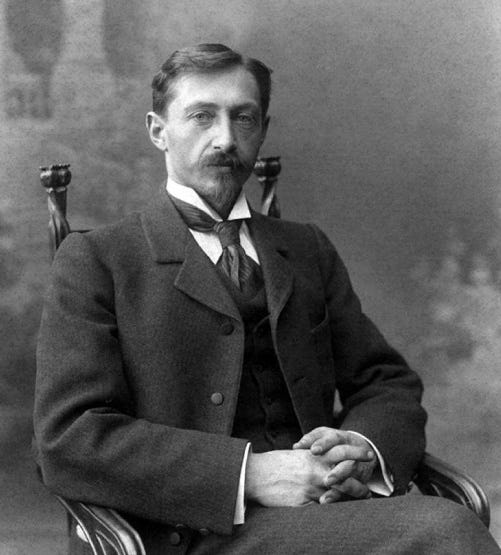
So, let’s do a list of Bunin’s most scalding insults of his famous contemporaries, in no particular order. These are all hilarious to me. This truly is a who’s who of early XX century Russian literature. Here is what he had to say about…
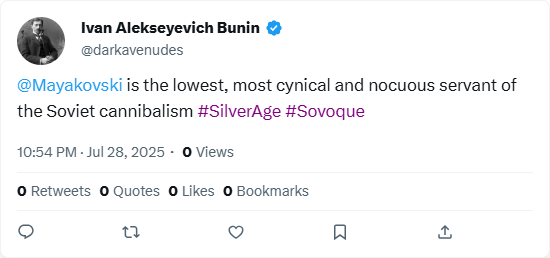
…Vladimir Mayakovsky, an extremely talented, extravagant Soviet poet:
Mayakovsky is the lowest and the most cynical and nocuous servant of the Soviet cannibalism.
…Isaac Babel, one of the most brilliant stylists in history:
One of the most vile blasphemers.
…Marina Tsvetaeva, whom Joseph Brodsky called the best poet of her age1:
Tsvetaeva with the never-ceasing downpour of wild words and sounds in her poems.
…Sergei Yesenin, one of the most popular and well-known Russian poets of the 20th century:
Sleep it off, and don’t breathe your messianic moonshine on me!
…Anatoly Marienhof, Yesenin’s friend and a brilliant writer in his own right2:
A blaggard and the greatest villain.
…Maxim Gorky, one of the most celebrated Soviet writers:
A terrible graphomaniac.
…Alexander Blok, a Russian poet:
An unbearably poetic poet. He hoodwinks the reader with his balderdash.
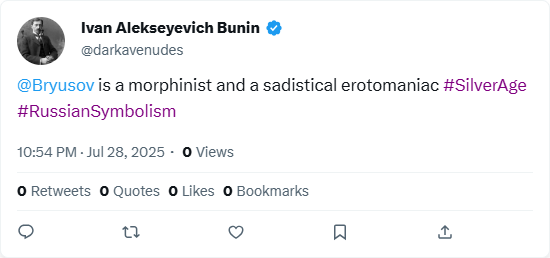
…Valery Bryusov, one of the founders of the Russian Symbolist movement:
Bryusov is a morphinist and a sadistical erotomaniac.
…Andrei Bely, a Russian novelist, Symbolist poet, and theorist:
There’s nothing left to say of his monkeyish atrocities.
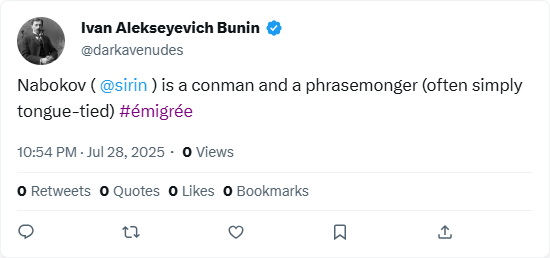
…Vladimir Nabokov, well, him you know:
Nabokov is a conman and a phrasemonger (often simply tongue-tied).
…Konstantin Balmont, one of the major figures of the Silver Age of Russian Poetry:
The most unbridled drunkard, who shortly before his death lapsed into vicious erotic lunacies.
…Maximilian Voloshin, a poet and a critic:
A fat and curly-haired aesthete.
…Mikhail Kuzmin, a Russian poet, musician, and novelist (Bunin went all in on this one):
A pederast with a half-naked skull and a sepulchral face, painted like a whore’s corpse.
…Leonid Andreyev, a playwright, who is considered to be a father of Expressionism in Russian literature:
A hard-drinking tragedian.
…Zinaida Gippius, a Russian poet3:
An extraordinarily repugnant little soul.
…Velimir Khlebnikov, a prominent figure in the Russian Futurist movement, considered "the greatest world poet of our century" by some critics:
A rather gloomy fellow, silent, either a drunk or pretending to be a drunk.
…Fyodor Dostoyevsky, again, no need to comment:
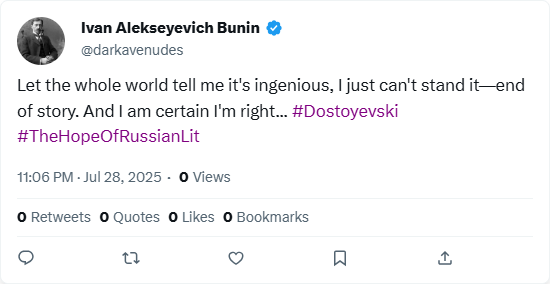
All of those deranged Kirillovs, Svidrigailovs, Ivans Karamazovs, all kinds of Lyadaschenks and Ferdyschenks, I just cannot stand them intrinsically. Let the whole world tell me it is ingenious, I just can’t stand it—end of story. And I’m certain I am right…
Although, to be fair, in the same discussion, Bunin also said:
“But there is something remarkable in his works. That penniless, dank, dark Petersburg, the rain, the muck, leaking galoshes, staircases, and cats, that hungry Raskolnikov with glowing eyes and an axe under his armpit, going up to see the old pawnbroker… this is remarkable. Pushkin’s Petersburg—shiny, dressed up, “I love you, Peter’s creation”—and he [Dostoyevsky] was the first one to show something different, the seamside of the Pushkin’s one…”
“But what about Gogol?”
“Yes, Gogol, that’s right… Akaky Akakievich, and there or thereabouts… that’s right! But Gogol—he’s a lubok4 writer. A great one, an outstanding one, a phenomenal one, and yet—lubok.
You see, even when Bunin was praising someone, he could not refrain from attacking someone else. I feel if Bunin had a Twitter account, he would blend right in. And also, being insulted by Bunin feels almost like a badge of honor. Although, that might be only applicable in literature: he also called Hitler and Mussolini "rabid monkeys".
At least two of the insults from the list above have additional context. It is well-documented that Bunin once was very close to Gorky. For example, here is a quote from one of his letters to Gorky:
You truly are one of those very few of whom my soul ponders as I write and whose support it appreciates so much.
However, Gorki was a staunch supporter of the revolution, and Bunin was a passionate anti-Soviet (see his quote about Mayakovsky). That political difference killed their friendship. In his essays of the 1920s, Bunin referred to Gorky as a “propagandist of the Soviet state.” Gorki also didn’t hold back. In one letter he mentioned that Bunin “went through the roof.” In another letter, he wrote that “Mitya's Love” is simply a rewrite of “The Kreutzer Sonata”5.
Another story of a longer feud is that of Bunin and Nabokov. Nabokov, being of a younger generation, respected and to some degree revered Bunin. In 1926, Nabokov sent Bunin his first published novel, “Mary”. He inscribed it with this:
Much esteemed and dearest Ivan Alekseyevich, I’m sending you my first book, filled with both joy and fear. I beg you, do not judge me too harshly.
Yours with all my soul,
V. Nabokov
This specific book copy survived in Bunin’s archive. On one of the pages, Bunin left a handwritten note: “Oh, how bad!”
That was apparently not the end of Bunin and Nabokov’s relationship. Some ten years later, Nabokov wrote to his wife that he met Bunin, who “resembled an old, gaunt tortoise, wiggling its dim-eyed, ancient head.”
Even later, in his autobiography, “Speak, Memory”, Nabokov wrote:
Another independent writer was Ivan Bunin. I had always preferred his little-known verse to his celebrated prose. At the time I found him tremendously perturbed by the personal problem of aging. The first thing he said to me was to remark with satisfaction that his posture was better than mine, despite his being some thirty years older than I. He was basking in the Nobel prize he had just received and invited me to some kind of expensive and fashionable eating place in Paris for a heart-to-heart talk. […] Bunin, a spry old gentleman, with a rich and unchaste vocabulary, was puzzled by my irresponsiveness to the hazel grouse of which I had had enough in my childhood and exasperated by my refusal to discuss eschatological matters. Toward the end of the meal we were utterly bored with each other. “You will die in dreadful pain and complete isolation,” remarked Bunin bitterly as we went toward the cloakroom. […] I wanted to help Bunin into his raglan but he stopped me with a proud gesture of his open hand. Still struggling perfunctorily—he was now trying to help me—we emerged into the pallid bleakness of a Paris winter day. My companion was about to button his collar when a look of surprise and distress twisted his handsome features. Gingerly opening his overcoat, he began tugging at something under his armpit. I came to his assistance and together we finally dragged out of his sleeve my long woolen scarf which the girl had stuffed into the wrong coat. The thing came out inch by inch; it was like unwrapping a mummy and we kept slowly revolving around each other in the process, to the ribald amusement of three sidewalk whores. Then, when the operation was over, we walked on without a word to a street corner where we shook hands and separated.
After reading this book (first published in English under the title “Conclusive Evidence: A Memoir”), Bunin wrote in his diary:
V. Nabokov wrote and published a book […] with cursory remarks about émigré writers that he met in Paris in the 30s. There is a page about me as well, like as if I once dragged him into an expensive Russian restaurant, to sit down, have a drink and, with him, Nabokov, a heart-to-heart, like all Russians like to do, and he apparently can’t stand it. That is so like me, isn’t it!? I have never been in any restaurant with him in my life.
As you can see, memory does speak, but it says different things to different people.
Was there someone Bunin actually liked? Yes! He definitely adored Chekhov, both personally and professionally. In one of his letters we find this tender moment:
I am taking a steamer to Odessa. I was held back in Yalta by Chekhov, who arrived there as well. I spent a marvelous week with him. If you only knew what kind of a man he was!”
And, a bit later, he wrote in his diary:
With no other writer had I such a fellowship as I did with Chekhov. For all the time with him, there was never a moment of unpleasantness. He was invariably restrained and delicate, welcoming, watched out for me as a senior.
And of course, perhaps unsurprisingly, Bunin also quite liked himself. His secretary, student, and, perhaps, lover, Galina Kuznetsova, wrote in her memoirs:
He often said with sorrow and some pride that with him, the true Russian language will also die—its wit (folk speech), its vividness, its kernel.
What can we learn from this impressive bibliography of insults and quips? Never cross Bunin? Be careful what you write on the internet (or in private letters or diaries)? Don’t pay much attention to the twitter muck? Or do, since it may come from a future Nobel laureate?
Nah.
I’m afraid, this post, like many others, will come without a takeaway or a moral in the end.
But if you do desire to insult someone, please consider “sepulchral face, painted like a whore’s corpse.”
Some shameless self-promotion.
If you’d like to support this journal and get an amazing anthology out of it, you can support us on Kickstarter
RIGHT HERE! (And RIGHT NOW!)
The anthology features works from nineteen incredible writers (and one from yours truly).
Best,
Ꙝ
Tsvetaeva herself wrote about Bunin: “I don’t like him: a cold, cruel, arrogant aristocrat. I don’t like him, but his wife—I do, very much so.” Seeing as Tsvetaeva was bisexual and had multiple affairs with women, one can interpret this quote in various ways.
Gippius’s husband, Dmitry Merezhkovsky, a prominent Russian writer, was nominated for a Nobel Prize together with Bunin. He once suggested that they divide the prize between the two, should one of them get it. Bunin refused.
Here Bunin is referring to “Lubok”—a woodcut and later lithographic genre associated with primitivism, provincialism, and naïveté. He was basically calling Gogol a “comic-strip writer”.
It is not really true. There might be similar themes, that’s all.
ahahhaaa I also noticed all that when reading him, and frankly was so amused (taken aback too, but amused), -and I did pay attention that even Bunin who seemed to hate all, still didn't have a bad word to say, about Chekhov.
I wonder, was it ever somebody who didn't love Chekhov?...
Thank you so much for writing this essay, Konstantin, truly you made my day a bit brighter!
And you're right of course...people are people
I remember- when reading LiveJournal when it was still its golden age -such awful scandals between poets, who otherwise wrote most lyrical verses one can imagine. Что за клубок змей, с ужасом думал я.
PS coincidentally I translated an excerpt from some Tsvetaeva's work...Larisa gave me courage to attempt, as usual. Made me briefly happy. Come and see when/if you have couple minutes.
Great piece! Nice to see Arts and Letters pick this up as well.